

Ativan/Lorazepam Withdrawal Timeline
How Long Does Ativan Withdrawal Last?
Ativan (lorazepam) is a benzodiazepine prescribed for anxiety, insomnia, and seizure disorders. It works by enhancing the effects of GABA, a neurotransmitter that calms brain activity. While Ativan can be effective for short-term use, the body can develop a physical dependence on it relatively quickly, sometimes within just a few weeks of daily use.
When someone who has become dependent on Ativan stops taking it, the brain struggles to function normally without the drug. This is when withdrawal symptoms begin. Ativan withdrawal can range from uncomfortable to medically serious, depending on the dosage, how long the person has been using it, and whether they stop abruptly or taper gradually. Understanding what to expect and how to approach it safely makes a real difference in the outcome.
Is Ativan a Controlled Substance? Ativan’s Schedule
Yes. Ativan (lorazepam) is a Schedule IV controlled substance under the federal Controlled Substances Act, the same schedule as every other benzodiazepine, including Xanax, Valium, and Klonopin. Schedule IV means the drug has an accepted medical use and a lower potential for abuse than drugs in Schedules I through III, but that it can still produce physical dependence. That is why a lorazepam prescription can be refilled at most five times within six months before a new prescription is required, and why pharmacies track it.
“Schedule IV” is a legal category, not a measure of how hard the drug is to stop. Dependence on Ativan can develop within a few weeks of daily use, and withdrawal from it is among the more dangerous drug withdrawals because of the seizure risk. If you searched for “Ativan schedule” looking for a tapering schedule rather than the drug’s legal status, that is covered below.
Ativan Withdrawal Symptoms
Ativan withdrawal symptoms can be both physical and psychological. Because benzodiazepines suppress nervous system activity, the brain essentially rebounds when the drug is removed, leading to a state of overexcitation. This is what drives most of the symptoms people experience.
Common Ativan withdrawal symptoms include:
- Anxiety and panic attacks. Often more intense than the anxiety Ativan was originally prescribed to treat. This “rebound anxiety” is one of the earliest and most common symptoms.
- Insomnia and sleep disruption. Difficulty falling asleep, staying asleep, or experiencing restful sleep. Vivid or disturbing dreams are also common.
- Irritability and mood swings. Emotional volatility that can feel out of proportion to the situation.
- Tremors and muscle tension. Shaking, especially in the hands, along with overall muscle stiffness and aches.
- Headaches. Ranging from mild tension headaches to more severe, persistent pain.
- Nausea and sweating. Digestive discomfort and temperature regulation issues are common during the acute phase.
- Difficulty concentrating. Brain fog, memory issues, and trouble focusing on tasks.
- Increased heart rate and blood pressure. The nervous system overcorrects without the drug’s calming effect.
- Seizures (in severe cases). This is the most serious risk of benzodiazepine withdrawal and is why medical supervision is strongly recommended. Seizures are more likely with abrupt cessation after heavy, prolonged use.
The severity of symptoms depends largely on dosage, duration of use, and whether the person tapers off gradually or stops cold turkey. People who have been taking higher doses for longer periods tend to experience more intense withdrawal.
Ativan Half-Life and When It Peaks
Ativan is an intermediate-acting benzodiazepine with a half-life of roughly 10 to 20 hours, averaging around 12. A tablet taken by mouth reaches its peak level in the blood about two hours after the dose, and the calming effect is strongest for the first six to eight hours. Because the half-life is much shorter than Valium’s (which can run past 48 hours once its active metabolites are counted) but longer than Xanax’s (about 11 hours, with a faster drop-off), Ativan sits in the middle of the benzodiazepine range for how quickly withdrawal arrives.
In practical terms: after a missed dose, Ativan’s level in the body has fallen by half within about half a day, and most of it is gone in two to three days. That is the window in which withdrawal starts, and it is why the timeline below begins at hour 8 rather than day 3.
When Does Ativan Withdrawal Start?
Withdrawal symptoms typically begin within 24 to 48 hours after the last dose, though some people notice the first signs of rebound anxiety within 8 to 12 hours.
The timing is faster than longer-acting benzodiazepines like Valium (diazepam), which has a half-life of 20 to 100 hours. With Valium, withdrawal may not begin for several days. On the other hand, shorter-acting benzos like Xanax (alprazolam) can produce withdrawal symptoms even more quickly.
This is one of the reasons why stopping Ativan abruptly is not recommended. The relatively fast onset of withdrawal means the body doesn’t have much time to adjust, which increases the risk of severe symptoms, including seizures. A medically supervised taper is the safest approach.
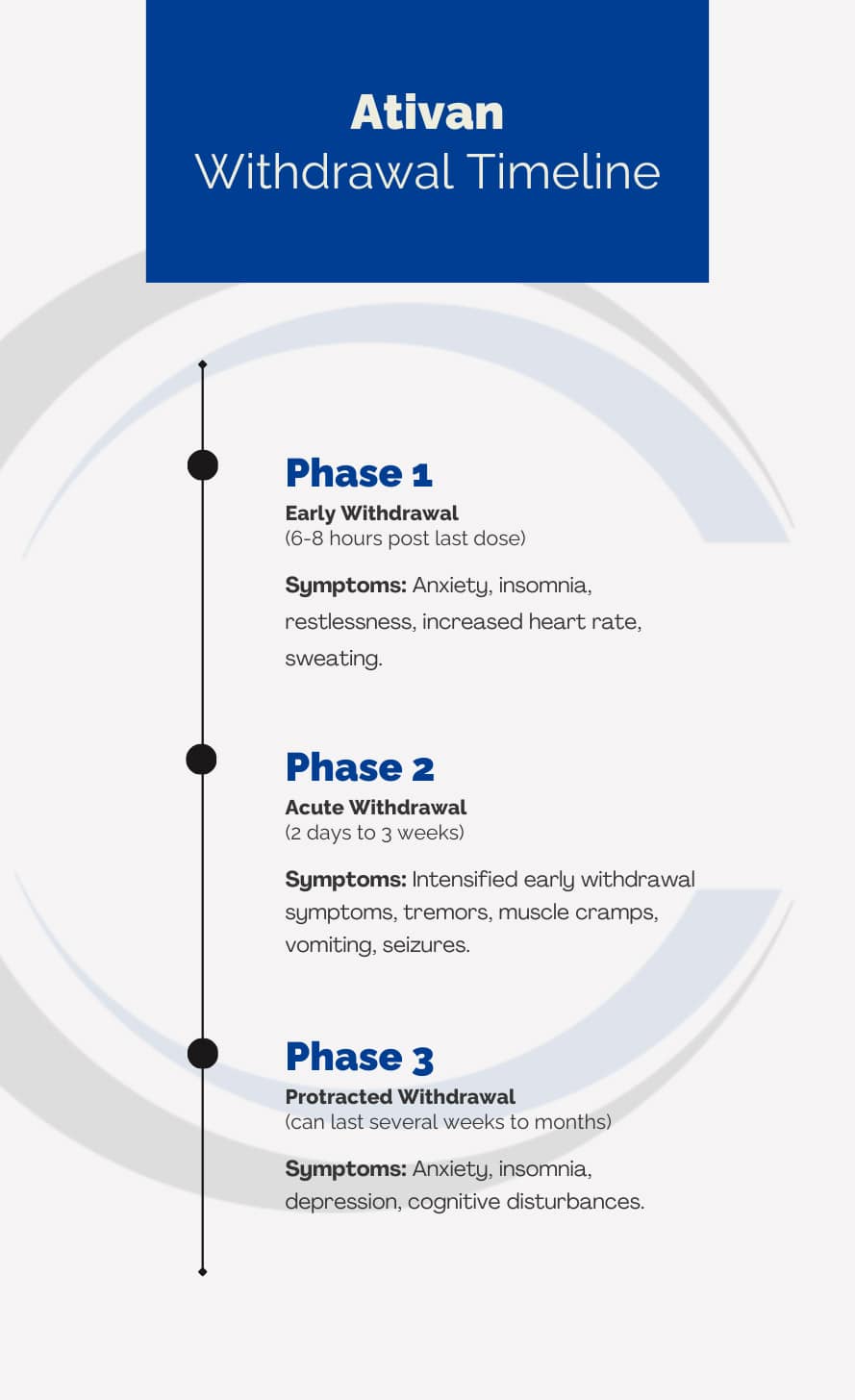
Ativan Withdrawal Timeline
While every person’s experience is different, Ativan withdrawal generally follows a predictable pattern. The timeline below reflects what most people can expect when tapering off or discontinuing lorazepam.
| Timeframe | What’s Happening | Common Symptoms |
|---|---|---|
| Hours 8 to 24 | The drug begins to leave the body. Early withdrawal signs emerge as GABA activity drops. | Rebound anxiety, restlessness, difficulty sleeping, mild irritability. These can feel like the original symptoms Ativan was treating, but more intense. |
| Days 1 to 4 | Acute withdrawal begins. The nervous system is adjusting to functioning without the drug. | Heightened anxiety, insomnia, tremors, sweating, nausea, headaches, muscle tension, increased heart rate. This is typically the most physically uncomfortable phase. |
| Days 5 to 14 | Symptoms peak and then begin to gradually improve. The brain is starting to recalibrate its natural GABA production. | Anxiety and insomnia may still be present but begin to lessen. Physical symptoms like tremors and sweating typically improve. Mood swings and difficulty concentrating may persist. |
| Weeks 2 to 4 | Most acute symptoms have resolved. Recovery continues as the nervous system stabilizes. | Lingering anxiety, sleep disruption, and mood issues are possible but less intense. Energy and mental clarity continue to improve. |
| Weeks 4+ | Post-acute withdrawal syndrome (PAWS) can occur in some individuals, especially those who used Ativan heavily or for extended periods. | Intermittent anxiety, depression, sleep problems, and difficulty with stress management. These symptoms come and go and gradually decrease over weeks to months. |
People who used higher doses or took Ativan for more than a few months are more likely to experience a longer withdrawal timeline. Those with co-occurring mental health conditions may also find that symptoms like anxiety and depression take longer to stabilize, which is why integrated treatment that addresses both issues simultaneously tends to produce better outcomes.
How Ativan Withdrawal Compares to Other Benzodiazepines
Not all benzodiazepine withdrawals are the same. The primary differences come down to how quickly the drug leaves the body (its half-life) and how potent it is.
Compared to Valium, which is a long-acting benzo, Ativan withdrawal tends to start sooner and peak faster. The tradeoff is that it also resolves more quickly. Valium withdrawal can take longer to begin but may produce a more gradual, drawn-out set of symptoms.
Compared to Xanax, Ativan withdrawal is somewhat more moderate. Xanax has a shorter half-life and higher potency, which tends to produce faster-onset and more intense withdrawal symptoms. Klonopin (clonazepam) falls somewhere in between, with a longer half-life that leads to a more gradual withdrawal curve.
Regardless of which benzodiazepine is involved, medical supervision during withdrawal is important. Seizure risk exists with all benzos, and a proper tapering schedule, often using a longer-acting benzo like Valium as a bridge, is the standard of care.
How to Detox from Ativan Safely
The safest way to stop taking Ativan is through a gradual, medically supervised taper. This means slowly reducing the dose over a period of weeks or months, giving the brain time to adjust to lower levels of the drug. A tapering schedule should always be designed and monitored by a healthcare provider.
Stopping Ativan abruptly, especially after prolonged use, is medically risky. Cold-turkey cessation can trigger seizures, severe panic attacks, and in rare cases, a condition similar to delirium tremens. This is not a drug you should discontinue on your own without medical guidance.
During a supervised taper, your provider may:
- Reduce your Ativan dose by 10 to 25% at regular intervals
- Switch you to a longer-acting benzodiazepine like Valium, which produces a smoother withdrawal curve
- Prescribe adjunct medications to manage specific symptoms like insomnia, anxiety, or muscle tension
- Monitor your vital signs and adjust the schedule based on how you’re responding
A Typical Ativan Tapering Schedule
There is no single correct Ativan taper. The schedule depends on the starting dose, how long you have been taking it, other medications, and how you respond to each step down. What follows is an example for someone on 2 mg a day, so you can see the shape of a supervised taper. It is not a plan to follow on your own.
| Step | Daily dose | Reduction | Typical length |
|---|---|---|---|
| Start | 2 mg | ||
| 1 | 1.5 mg | 25% | 1 to 2 weeks |
| 2 | 1.25 mg | ~17% | 1 to 2 weeks |
| 3 | 1 mg | 20% | 1 to 2 weeks |
| 4 | 0.75 mg | 25% | 2 weeks |
| 5 | 0.5 mg | ~33% | 2 weeks |
| 6 | 0.25 mg | 50% | 2 weeks |
| 7 | Stop | Monitor for 2 to 4 weeks |
A few things to notice. The cuts get smaller in milligrams as the dose falls, because the last 0.5 mg is usually the hardest part of the taper and the point where most people need the slowest steps. Each step is held until symptoms settle before the next reduction; a step that produces bad rebound anxiety or insomnia gets extended, not pushed through. And for people who have taken Ativan daily for a year or more, prescribers often go slower than this table, closer to 5 to 10 percent every two to four weeks, which can put the whole taper at several months.
Some providers convert the Ativan dose to an equivalent dose of a long-acting benzodiazepine, usually Valium (diazepam), and taper that instead. Roughly 1 mg of lorazepam equals 10 mg of diazepam. The longer half-life smooths out the drop between doses and makes small reductions easier, since diazepam comes in 2 mg tablets that can be split. Whichever route is used, the taper is managed by a prescriber who can see you, adjust the schedule, and add short-term support for sleep or anxiety when a step is rough.
Treatment and Support for Ativan Withdrawal
Medical tapering addresses the physical side of withdrawal, but long-term recovery usually requires more than just getting off the drug. Many people who develop Ativan dependence were originally prescribed the medication for a real condition, most often anxiety. Without addressing that underlying issue, the risk of relapse is high.
Effective treatment combines medical support with therapeutic approaches:
- Cognitive behavioral therapy (CBT) helps identify and change the thought patterns that drive anxiety, reducing the need for medication over time.
- Mindfulness and relaxation techniques provide non-pharmaceutical tools for managing anxiety and stress.
- Regular exercise has been shown to naturally boost GABA and serotonin levels, which are the same systems affected by benzodiazepines.
- Support groups connect you with others who understand what benzo withdrawal is like and can offer perspective and accountability.
The Massachusetts Center for Addiction in Quincy, MA offers structured treatment programs designed for people going through benzodiazepine withdrawal. Our partial hospitalization program (PHP) provides intensive daily support while allowing you to return home each evening. For those who need more flexibility, our intensive outpatient (IOP) and outpatient programs offer structured therapy around your existing schedule.
If anxiety, depression, or another mental health condition was behind your Ativan use in the first place, our team treats both issues together through dual diagnosis treatment. We accept most major insurance plans, and our admissions team is available 24/7 at 844-486-0671.
Frequently Asked Questions
The acute phase of Ativan withdrawal typically lasts 1 to 2 weeks, with symptoms peaking around days 3 to 7. Some people experience post-acute withdrawal symptoms (PAWS) that can persist for weeks or months, including intermittent anxiety, sleep problems, and mood swings. The total duration depends on dosage, length of use, and whether you taper gradually or stop abruptly.
Common symptoms include rebound anxiety, insomnia, irritability, tremors, headaches, nausea, sweating, difficulty concentrating, and increased heart rate. In severe cases, particularly with abrupt cessation after heavy use, seizures can occur. This is why medical supervision during Ativan withdrawal is strongly recommended.
Stopping Ativan abruptly is not recommended and can be medically dangerous. Cold-turkey cessation can trigger seizures, severe panic attacks, and other serious complications. The safest approach is a gradual taper under medical supervision, where the dose is reduced slowly over weeks or months.
Xanax withdrawal tends to be more intense because Xanax has a shorter half-life and higher potency, meaning it leaves the body faster, and the rebound effect is sharper. Ativan withdrawal is generally considered moderate among benzodiazepines. That said, withdrawal from any benzodiazepine can be serious, and medical supervision is important regardless of which one is involved.
Yes. Seizures are a known risk of benzodiazepine withdrawal, including Ativan. The risk is highest when the drug is stopped abruptly after prolonged use at high doses. A gradual taper significantly reduces this risk, which is why medical supervision is the standard of care for benzodiazepine discontinuation.
A typical Ativan taper involves reducing the dose by 10 to 25% at regular intervals, usually every 1 to 2 weeks. In some cases, a doctor may switch the patient to a longer-acting benzodiazepine like Valium to produce a smoother withdrawal. The exact schedule depends on the starting dose, duration of use, and how the patient responds to each reduction.
A doctor or addiction treatment center experienced with benzodiazepine withdrawal can help you create a safe tapering plan and provide medical monitoring throughout the process. The Massachusetts Center for Addiction in Quincy, MA offers partial hospitalization, intensive outpatient, and outpatient programs for benzodiazepine dependence. Call 844-486-0671 for a free, confidential consultation.


Contact Us

Address
Quincy, MA 02169


Start your recovery with
Massachusetts Center for Addiction
Our team is available 24 hours a day, 7 days a week to answer any questions you may have. Give us a call today and begin your journey toward long-term recovery.