Tranq Drug (Xylazine) Effects, Wounds and Overdose Risk
Tranq is the street name for xylazine, an animal sedative that has been mixed into the fentanyl supply. It causes heavy sedation, slows breathing and heart rate, and can cause severe skin wounds that are slow to heal.
Most people who are exposed to tranq did not choose it. It shows up in what is sold as fentanyl or heroin, sometimes called tranq dope, and in Massachusetts it has been found in a large share of tested samples.
Below is what tranq is, what it does, why Narcan still matters, how to care for tranq wounds, and what treatment looks like.
What Is Tranq
Xylazine is a tranquilizer and pain reliever approved by the FDA only for use in animals, according to the National Institute on Drug Abuse. It is not an opioid, and it is not approved for people.
In the illicit supply it is mixed mostly with fentanyl. People who use it describe a longer, heavier sedation than fentanyl alone, and it is cheap, which is part of why it spread.
The DEA found xylazine in about 23 percent of fentanyl powder and 7 percent of fentanyl pills it seized in 2022. On the street it is called tranq or, mixed into fentanyl, tranq dope.
Tranq in Massachusetts
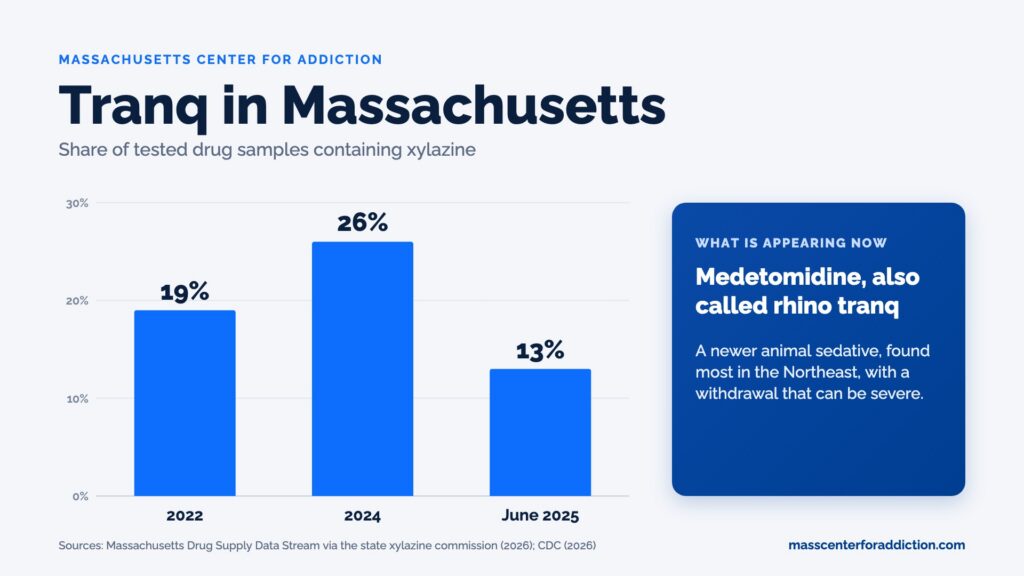
Massachusetts tracks xylazine through the Massachusetts Drug Supply Data Stream (MADDS), which tests samples collected by harm reduction programs. The figures below were reported to the state commission on xylazine in 2026.
| Period | What was found |
|---|---|
| 2022 | Xylazine in 19% of MADDS samples; present in 5% of opioid overdose deaths as of mid-2022 |
| 2024 | Xylazine in 26% of samples |
| June 2025 | Down to 13%, as medetomidine, another animal sedative, began appearing |
The commission recommended treating tranq as a public health problem, expanding low-barrier care, and training providers on newer contaminants, including medetomidine and nitazenes.
What Tranq Does to the Body
Xylazine is a central nervous system depressant. It can make people very drowsy and slow breathing, heart rate, and blood pressure to dangerously low levels.
Combined with fentanyl, that means deeper sedation and a higher risk of overdose. People can be unconscious for hours, which leaves them exposed to injury, assault, and pressure wounds from lying in one position.
Tranq Wounds
Xylazine is linked to severe skin ulcers, and the Massachusetts commission noted they can take months or years to heal. They can start as small sores or blisters and turn into deep, dark wounds, and they do not only appear at injection sites.
Wounds can become infected and, left untreated, can lead to serious infections and loss of a limb. Early care makes a real difference.
The Philadelphia Department of Public Health recommends these basics for caring for a wound at home:
- Clean it with soap and water or saline, with clean hands or gloves
- Keep it moist with a barrier ointment such as petroleum jelly and a nonstick dressing
- Cover it with absorbent gauze, wrapped snugly but not tight
- Change the dressing every 1 to 3 days
Get medical care right away for increasing pain, heavy drainage, a bad smell, skin that is hot, red, or swollen, visible bone or tendon, fever or chills, or numbness. Many Massachusetts harm reduction programs offer wound care without judgment.
Does Narcan Work on Tranq
Narcan (naloxone) does not reverse xylazine, because xylazine is not an opioid. But you should still give it.
Tranq is almost always mixed with fentanyl, and naloxone reverses the fentanyl, which is what stops breathing in most overdoses. NIDA and the CDC both recommend giving naloxone in any suspected overdose.
After giving naloxone, call 911, support their breathing, and put them in the recovery position. Someone may keep breathing but stay sedated from the xylazine, which is expected, so stay with them until help arrives.
Tranq Withdrawal
People who use tranq regularly can go through xylazine withdrawal on top of opioid withdrawal. Philadelphia’s health department describes irritability, anxiety, and a deep sense of unease, sometimes with a racing heart and high blood pressure.
This combination is harder to manage than fentanyl withdrawal alone, and standard opioid withdrawal treatment does not cover the xylazine part. It is a strong reason to go through withdrawal with medical support rather than alone.
Our fentanyl withdrawal timeline covers the opioid side of what to expect.
Medetomidine and the Newer Tranq
In 2025 and 2026 a second animal sedative, medetomidine, started replacing xylazine in parts of the supply. On the street it is called rhino tranq, mede, or dex.
A CDC health alert in April 2026 reported that medetomidine is showing up in drug seizures, samples, and wastewater, with the highest concentrations in the Northeast. Stopping it after regular use can cause severe withdrawal with high blood pressure, anxiety, nausea, vomiting, and swings in alertness.
That withdrawal can be dangerous and needs medical care. As with xylazine, the CDC says to give naloxone in a suspected overdose, since fentanyl is involved in most.
Testing for Tranq in Massachusetts
Drug testing services, including test strips, are protected under Massachusetts law as amended by Chapter 285 of the Acts of 2024. Test strips are available through many harm reduction programs across the state.
Massachusetts also runs StreetCheck, a statewide drug checking program based at Brandeis University that operates in about 20 communities. It can identify xylazine, medetomidine, and other contaminants that a strip cannot.
Testing does not make the supply safe. It gives you information, and the safest option is treatment that ends the need to use from that supply at all.
Treatment for Fentanyl and Tranq Use
Treatment starts with the opioid use, since fentanyl is what most people are dependent on. Medications for fentanyl addiction, including buprenorphine and methadone, lower overdose risk, and our Suboxone vs. methadone guide explains the difference.
When xylazine or medetomidine is involved, withdrawal needs medical management. Our admissions team coordinates placement at an accredited detox facility, often the same day, and wounds get treated alongside withdrawal.
After detox, Massachusetts Center for Addiction in Quincy provides fentanyl addiction treatment through partial hospitalization and outpatient programs, with medication support managed within them. Call 844-486-0671, or reach the Massachusetts Substance Use Helpline at 800-327-5050.
Frequently Asked Questions About Tranq
Tranq is xylazine, an animal sedative approved only for veterinary use, that has been mixed into the illicit fentanyl supply. It causes heavy sedation, slows breathing and heart rate, and is linked to severe skin wounds.
Tranq dope is fentanyl or heroin mixed with xylazine. Most people who use it are buying fentanyl, and the xylazine comes with it, often without their knowledge.
Narcan does not reverse xylazine, because it is not an opioid. Give it anyway, because tranq is nearly always mixed with fentanyl, which Narcan does reverse. Then call 911 and support the person’s breathing.
They often start as small sores or blisters and can become deep, dark ulcers. They can appear away from injection sites and can take months or years to heal. Signs of infection, like heat, swelling, odor, or fever, need prompt medical care.
Yes. Massachusetts drug checking found xylazine in 19 percent of samples in 2022 and 26 percent in 2024, falling to 13 percent by mid-2025 as medetomidine began to appear.
People describe irritability, anxiety, and a deep sense of unease, sometimes with a racing heart and high blood pressure, on top of opioid withdrawal. It is harder to manage than fentanyl withdrawal alone and is safest with medical support.
Medetomidine is another animal sedative, called rhino tranq, that has started replacing xylazine in parts of the fentanyl supply, especially in the Northeast. Stopping it after regular use can cause severe withdrawal that needs medical care.
Drug testing services, including test strips, are protected under Massachusetts law as amended in 2024. Many harm reduction programs provide them, and the StreetCheck program offers more detailed testing in about 20 communities.
Clinically reviewed by Corey Gamberg, LADC II, Executive Director. This article is for educational purposes and is not a substitute for medical advice. If you are experiencing a medical emergency, call 911. For mental health crisis support, call or text 988.
Sources
- National Institute on Drug Abuse: Xylazine
- DEA: Widespread Threat of Fentanyl Mixed With Xylazine
- CDC Health Alert: Medetomidine in the U.S. Illegal Fentanyl Supply (April 2026)
- State House News Service: State Panel Urges Action on Rising Xylazine Risks (May 2026)
- Philadelphia Department of Public Health: Tranq
- Massachusetts Fentanyl Test Strips FAQ (February 2026)
- WBUR: Massachusetts StreetCheck Drug Checking
- Massachusetts Substance Use Helpline

Contact Us

Address
Quincy, MA 02169


Start your recovery with
Massachusetts Center for Addiction
Our team is available 24 hours a day, 7 days a week to answer any questions you may have. Give us a call today and begin your journey toward long-term recovery.