
What Is 7OH? Effects, Risks and the Massachusetts Ban
7OH, also written 7-OH, is short for 7-hydroxymitragynine. It is a compound found in tiny amounts in the kratom leaf that manufacturers concentrate or make in a lab and sell as tablets, gummies, drink shots, and vapes.
It acts on the same brain receptors as opioids, and it is far stronger than kratom itself. That is why the FDA, the DEA, and Massachusetts all moved against it in the summer of 2026.
Below is what 7OH is, how it compares with kratom, how long it lasts, whether it shows up on a drug test, and what the law says now.
What Is 7OH
7-hydroxymitragynine is one of the alkaloids in the leaves of Mitragyna speciosa, the Southeast Asian tree sold as kratom. In the natural leaf it makes up less than 2 percent of the alkaloid content, according to an FDA scientific assessment.
The products sold as 7OH are not leaf. Manufacturers purify mitragynine, the leaf’s main alkaloid, and convert it to 7OH in a lab, a process a University of Colorado pharmacologist described in 2025. The body also makes a small amount of 7OH on its own when it breaks down mitragynine.
These products turned up in gas stations, smoke shops, and convenience stores over the past two years, often next to energy shots at the register. FDA testing found some products carried 7OH at levels well above what was expected.
7OH vs Kratom
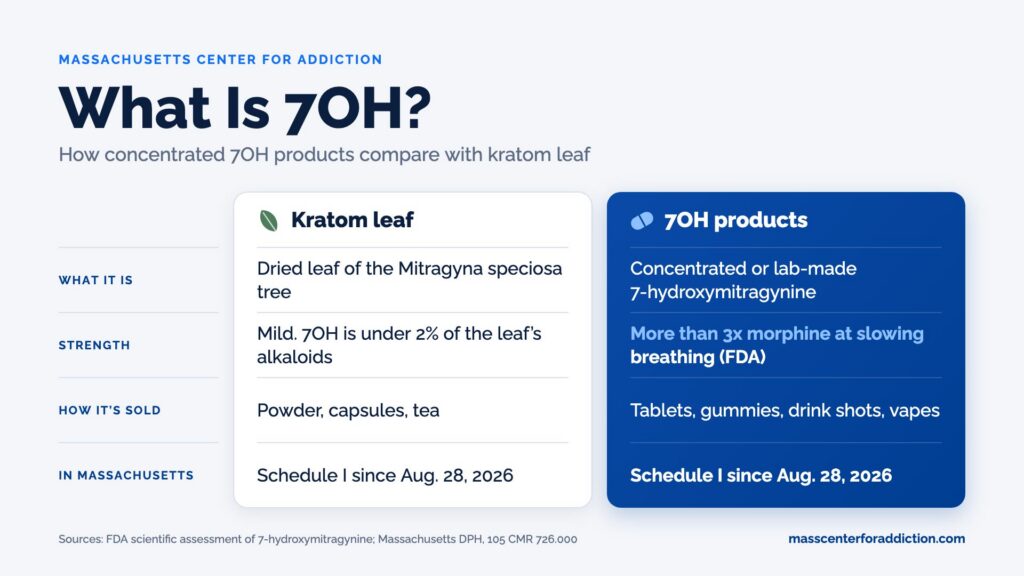
Kratom leaf and 7OH products are often sold side by side, and many people assume they are the same thing at different strengths. In practice, they behave like a mild opioid and a strong one.
| Kratom leaf | 7OH products | |
|---|---|---|
| What it is | Dried, ground leaves of the Mitragyna speciosa tree | Concentrated or lab-made 7-hydroxymitragynine |
| Main active compound | Mitragynine. 7OH is under 2 percent of the leaf’s alkaloids | 7OH, at many times the leaf’s natural level |
| Strength at opioid receptors | Milder | Much stronger. The FDA found it more than three times as potent as morphine at depressing breathing |
| How it is sold | Powder, capsules, tea | Tablets, gummies, drink shots, vapes |
| Federal status | Not federally controlled | Proposed for Schedule I, not yet final as of late September 2026 |
| Massachusetts status | Schedule I since August 28, 2026 | Schedule I since August 28, 2026 |
One pharmacology professor at CU Anschutz put the gap at “five to 50 times more potent than the normal kratom powder.” The range is wide because product strength varies so much from brand to brand.
Is 7OH an Opioid
7OH does not come from the opium poppy, but it works like an opioid. It binds to the mu-opioid receptors that morphine, oxycodone, and heroin act on.
That is why its risks follow the opioid pattern: tolerance, physical dependence, withdrawal, and overdose from slowed breathing. It is also why opioid treatments work on it, including naloxone for overdose and buprenorphine for dependence.
What 7OH Feels Like and How Long It Lasts
People describe pain relief, calm, and warmth, with euphoria and heavy sedation at higher doses. Nausea, constipation, itching, and drowsiness are common alongside those effects.
In studies the FDA reviewed, 7OH reached peak blood levels about 1 to 2 hours after a dose and had a half-life of roughly 2 to 5 hours. In plain terms, the effects build over the first hour or two and fade within several hours.
That short window matters. People tend to take another tablet or shot several times a day to keep the effect going, which keeps opioid receptors occupied around the clock and is how dependence builds faster than most people expect.
How Long 7OH Stays in Your System
Research on 7OH detection is still thin, so any number here is an estimate. Based on the half-life range the FDA reports, 7OH itself is mostly cleared from the blood within about 9 to 24 hours of a single dose.
Urine is a different question. Kratom urine tests look mainly for mitragynine, not 7OH, and 7OH products commonly contain mitragynine too.
How long either stays detectable depends on the dose, how often someone uses, how long they have been using, and their own metabolism. Daily, heavy use stretches every one of these windows.
Does 7OH Show Up on a Drug Test
Not on a standard one. Most workplace screens, including 5-panel and 10-panel tests, do not include kratom, according to the drug testing company DISA.
It does show up when a kratom test is specifically ordered. Labcorp notes that its kratom screen targets mitragynine, and because 7OH products usually contain mitragynine, they typically test positive.
If the question on your mind is whether a test will catch it, it may be worth asking a second one: whether you could stop for a few days without feeling sick. If the answer is no, that is dependence, and it is treatable.
7OH Side Effects
The FDA lists these risks from 7OH products:
- Addiction and physical dependence
- Anxiety and depression
- Stomach and digestive problems
- Insomnia
- Seizures
- Withdrawal symptoms such as restlessness, body aches, fatigue, irritability, and cold sweats
Day to day, people also report constipation, nausea, itching, sweating, and sleepiness. Over time, rising tolerance means more product for the same effect, which raises every one of these risks.
Can You Overdose on 7OH
Yes. Like other opioids, 7OH can slow breathing to a dangerous level, and the FDA’s assessment found it more than three times as potent as morphine at doing so.
The risk climbs sharply when 7OH is mixed with alcohol, benzodiazepines, sleep medications, or other opioids. In kratom-related deaths cited by CU Anschutz researchers, 93.5 percent involved at least one other substance, most often fentanyl. Tolerance also drops quickly after a break, so returning to an old dose is especially dangerous.
Signs of overdose include pinpoint pupils, slow or stopped breathing, blue or gray lips, and not waking up. Call 911 and give naloxone (Narcan) if you have it; it reverses opioid overdose, it works on 7OH, and it is sold at pharmacies without a prescription.
Is 7OH Legal
Last updated September 28, 2026.
Not in Massachusetts. The Department of Public Health placed all kratom products in Schedule I effective August 28, 2026, for up to one year, and the order covers 7OH, leaf kratom, and the related synthetic compounds. Our guide to the Massachusetts kratom ban covers what it means and the retailer lawsuit challenging it, which had not been ruled on as of late September.
Federally, the picture is still moving. The DEA placed three related synthetic compounds (mitragynine pseudoindoxyl, MGM-15, and MGM-16) in Schedule I effective August 26, 2026, but its proposal to schedule concentrated 7OH itself was still pending as of late September 2026.
The FDA has also stated that 7OH is not approved for any medical use and is not lawful as a dietary supplement or food ingredient.
When 7OH Use Turns Into Dependence
Dependence on 7OH usually does not announce itself. It tends to show up in patterns like these:
- Taking it on a schedule through the day rather than when you choose to
- Feeling sick, restless, or unable to sleep when you go without it
- Spending more than you planned, or buying more before you run out
- Using it mainly to stop feeling bad rather than to feel good
If that sounds familiar, the next step is understanding what stopping looks like. Our 7OH withdrawal timeline covers symptoms, how long they last, and why Suboxone often helps. The kratom withdrawal timeline covers leaf kratom.
Help for 7OH Dependence in Massachusetts
Massachusetts Center for Addiction treats 7OH and kratom dependence from our office at 1515 Hancock Street in Quincy. An assessment sorts out what you have been taking and how much, which decides whether you need medically supervised withdrawal or can start at the outpatient level.
When withdrawal needs medical supervision, our admissions team coordinates admission to an accredited detox facility, often the same day. Treatment with us picks up when detox ends, through our partial hospitalization and outpatient programs.
Medication support is managed within those programs where it is clinically appropriate. Massachusetts DPH notes that buprenorphine, one of the medications used for opioid use disorder, has been found effective for kratom use disorder.
We work with most major commercial insurance, and admissions can verify your benefits by phone before you commit to anything. Call 844-486-0671.
The state also runs the Massachusetts Substance Use Helpline around the clock. Call or text HOPE to 800-327-5050 for free, confidential help finding services anywhere in the state.
Frequently Asked Questions About 7OH
7OH is short for 7-hydroxymitragynine, a compound found in trace amounts in kratom leaf. Products sold as 7OH are concentrated or made in a lab and come as tablets, gummies, drink shots, and vapes. It acts on the same brain receptors as opioids and is much stronger than kratom leaf.
No. Kratom leaf contains mostly mitragynine, with 7OH making up under 2 percent of its alkaloids. 7OH products contain the compound at many times that level, and a CU Anschutz pharmacologist has described them as five to 50 times more potent than ordinary kratom powder.
It does not come from the opium poppy, but it acts like an opioid. 7OH binds to the same mu-opioid receptors as morphine and oxycodone, which is why it causes tolerance, dependence, withdrawal, and overdose risk, and why naloxone and buprenorphine work on it.
Based on the half-life reported by the FDA, roughly 2 to 5 hours, 7OH itself is mostly cleared from the blood within about 9 to 24 hours of a single dose. Urine tests look mainly for mitragynine, and detection windows depend on dose, how often and how long someone has used, and metabolism. Research specific to 7OH is still limited.
Not on standard workplace tests. Most 5-panel and 10-panel screens do not include kratom. A kratom-specific test does detect it, since those tests target mitragynine and 7OH products usually contain mitragynine.
Yes. 7OH can slow or stop breathing, and the FDA found it more than three times as potent as morphine at depressing respiration. The risk rises with alcohol, benzodiazepines, or other opioids. Call 911 and give naloxone if someone is unresponsive or breathing slowly.
No. Massachusetts placed all kratom products, including 7OH, in Schedule I effective August 28, 2026, for up to one year. A retailer lawsuit challenging the ban was pending without a ruling as of late September 2026.
Yes. Regular use produces tolerance and physical dependence, often quickly because people redose several times a day. Our 7OH withdrawal timeline covers what stopping looks like and what helps.
Clinically reviewed by Corey Gamberg, LADC II, Executive Director. This article is for educational purposes and is not a substitute for medical advice. If you are experiencing a medical emergency, call 911. For mental health crisis support, call or text 988.
Sources
- FDA: 7-Hydroxymitragynine (7-OH), An Assessment of the Scientific Data
- FDA: Products Containing 7-OH Can Cause Serious Harm
- DEA: Temporary Scheduling of 7-OH and Related Substances (July 1, 2026)
- Federal Register: Temporary Placement of Mitragynine Pseudoindoxyl, MGM-15, and MGM-16 in Schedule I
- Massachusetts Department of Public Health: Kratom (105 CMR 726.000)
- CU Anschutz: What Is 7-OH and Why Is It Being Targeted in Kratom Products
- DISA: 7-OH Kratom Risks for Employers
- Labcorp: Kratom and 7-Hydroxymitragynine (7-OH), Common Provider Questions
- Massachusetts Substance Use Helpline


Contact Us

Address
Quincy, MA 02169


Start your recovery with
Massachusetts Center for Addiction
Our team is available 24 hours a day, 7 days a week to answer any questions you may have. Give us a call today and begin your journey toward long-term recovery.