Oct 19, 2026
Adderall Withdrawal Symptoms, Timeline and the Crash
Adderall withdrawal usually means a hard crash for the first few days: exhaustion, heavy sleep, hunger, and a flat or low mood. The worst of it typically eases within about a week, though low energy, poor focus, and cravings can linger for several weeks.
It is rarely dangerous physically, but the depression can be serious. That, plus the fact that many people stopping Adderall still have ADHD to manage, is why it helps to have a plan.
Below is what withdrawal feels like, a day-by-day timeline, how the everyday Adderall crash differs from withdrawal, and what actually helps.
Adderall Withdrawal Symptoms
The FDA label for Adderall lists the symptoms that can follow stopping or cutting back after prolonged use:
- Low, irritable, or hopeless mood (dysphoria) and depression
- Fatigue and low energy
- Vivid, unpleasant dreams
- Sleeping far more than usual, or being unable to sleep
- Increased appetite
- Feeling slowed down, or restless and agitated
People also describe trouble concentrating, loss of motivation, anxiety, and strong cravings for Adderall. Most of these are the brain adjusting to working without a stimulant it has come to rely on.
Why Adderall Withdrawal Happens
Adderall raises the levels of dopamine and norepinephrine in the brain, the chemical messengers behind focus, energy, motivation, and reward. With steady use, the brain adjusts to that higher baseline and turns down its own signaling.
When the drug stops, the boost disappears before the brain has recalibrated. That gap is withdrawal: the low energy, flat mood, and cravings of a system running below where it has learned to expect.
The recalibration takes time, which is why the first week is the hardest and why focus and motivation often come back last.
The Adderall Crash vs Withdrawal
People use “crash” for three different experiences, and they call for different responses.
| Daily crash | Comedown after heavy use | Withdrawal | |
|---|---|---|---|
| When it happens | As a dose wears off, often late afternoon | After taking more than prescribed or staying up on it | After stopping or cutting back following long-term use |
| How it feels | Tired, irritable, foggy, hungry | Exhausted, low, anxious, needing to sleep | Low mood, fatigue, sleep changes, cravings |
| How long | A few hours | One to a few days | Most severe in the first week, some symptoms for weeks |
| What it points to | Dose timing or formulation | Misuse pattern worth looking at | Physical dependence |
A daily crash in someone taking Adderall as prescribed is usually a timing problem. Talk to your prescriber about dose timing or an extended-release form rather than taking more.
Repeated comedowns after taking extra, or feeling unable to function without Adderall, are different. They are signs that use has moved past what was prescribed, which our guide on whether Adderall addiction requires rehab covers.
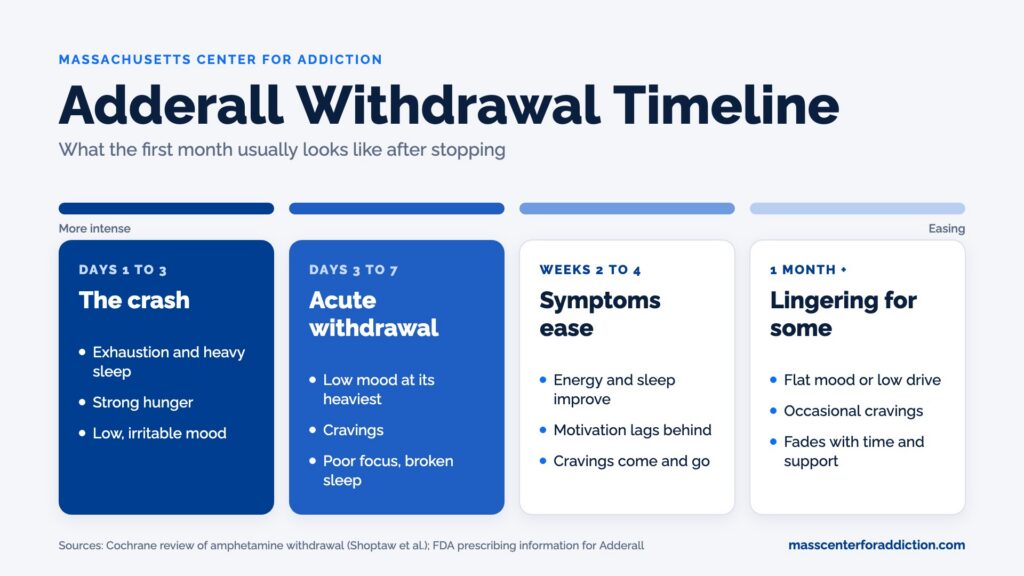
Adderall Withdrawal Timeline
The Cochrane review of amphetamine withdrawal describes withdrawal as an initial crash that resolves within about a week, with some symptoms continuing for weeks or months. The typical shape looks like this:
| Time since last dose | What is happening | How it tends to feel |
|---|---|---|
| First 1 to 3 days | The crash | Exhaustion, sleeping much longer than usual, hunger, low mood, irritability |
| Days 3 to 7 | Acute withdrawal | Low mood at its heaviest, cravings, poor concentration, broken sleep |
| Weeks 2 to 4 | Symptoms ease | Energy and sleep improve unevenly; motivation and focus lag behind |
| 1 month and beyond | Lingering symptoms for some | Flat mood, low drive, cravings that come and go |
Amphetamine has a half-life of roughly 10 to 11 hours, so the crash usually starts within the first day. People who took high doses for a long time, or who stop all at once, tend to have a harder and longer course.
If flat mood and cravings stretch past the first month, that is often post-acute withdrawal. It fades with time, and treatment makes it much easier to get through.
How Long Does an Adderall Crash Last
A daily crash as a dose wears off lasts a few hours. A comedown after taking more than usual or going without sleep usually clears in one to a few days with rest and food.
If you feel crashed for more than a few days after stopping, you are likely in withdrawal rather than a crash, and the timeline above applies.
Is Adderall Withdrawal Dangerous
Physically, Adderall withdrawal is not usually dangerous the way alcohol or benzodiazepine withdrawal can be. It does not typically cause seizures or life-threatening complications.
The risk is mental. Depression in the first week can be intense, and some people have thoughts of suicide, especially after heavy use or with a history of depression.
If you or someone you love is having thoughts of suicide, call or text 988, the Suicide and Crisis Lifeline, any time. If someone is in immediate danger, call 911.
Adderall Withdrawal When You Have ADHD
If you have ADHD, some of what you feel after stopping is not withdrawal. It is your ADHD symptoms returning without treatment: distractibility, disorganization, restlessness, and trouble starting tasks.
The difference matters. Withdrawal symptoms fade over weeks, while ADHD symptoms stay, so it helps to plan with your prescriber for how you will manage them, whether with a different medication, a non-stimulant option, or therapy and structure.
Stopping a prescribed stimulant because of side effects or a shortage is different from stopping because of misuse. Either way, telling your prescriber what is really going on gets you a safer plan.
Signs Adderall Use Has Become a Problem
Withdrawal on its own does not mean addiction; it can happen at prescribed doses. These patterns suggest use has moved beyond what is helping:
- Taking more than prescribed or running out early
- Using someone else’s Adderall or buying it
- Crushing, snorting, or taking it to stay up for long stretches
- Feeling unable to work, study, or get through the day without it
- Continuing despite anxiety, weight loss, poor sleep, or heart symptoms
If several of these fit, our Adderall addiction page covers the warning signs in more detail.
Should You Taper Off Adderall
If Adderall is prescribed to you, talk to your prescriber before stopping. They can lower the dose gradually, which usually softens the crash, and plan for how your ADHD will be managed afterward.
If you have been taking more than prescribed or using Adderall that is not yours, stopping is still the right move. A clinician can help you decide whether to stop at once or step down, and what support you need for the first two weeks.
Our post on whether you can take Adderall for life covers long-term prescribed use.
What Helps With Adderall Withdrawal
The Cochrane review found no medication proven to treat amphetamine withdrawal itself, so care focuses on getting through the first weeks safely and treating what sits underneath. What helps most:
- Sleep as much as your body asks in the first days, then return to a regular wake time
- Eat regular meals with protein, since appetite returns fast
- Move a little each day, even a short walk, which helps mood and sleep
- Clear your schedule where you can for the first week and tell someone you trust what you are doing
- Remove your supply so a hard afternoon does not turn into a relapse
- Get depression and ADHD evaluated rather than waiting to see if they pass
Adderall Detox and Treatment
Most people do not need inpatient detox for Adderall. When withdrawal needs medical supervision because of severe depression, other substances, or medical conditions, our admissions team coordinates placement at an accredited detox facility.
For most people, treatment for Adderall addiction happens in outpatient or partial hospitalization care. Therapy focuses on why the stimulant became necessary, whether that is work or school pressure, untreated ADHD, depression, or other stimulant use.
When ADHD or depression is part of the picture, dual diagnosis treatment addresses both at once. Massachusetts Center for Addiction treats stimulant use from our office in Quincy, and admissions can verify your insurance by phone at 844-486-0671.
Frequently Asked Questions About Adderall Withdrawal
The initial crash and the most severe symptoms usually resolve within about a week. Low energy, poor focus, flat mood, and cravings can continue for several weeks, and for some people longer after heavy, long-term use.
Most people describe deep exhaustion, sleeping far more than usual, strong hunger, and a low or irritable mood in the first days. Trouble concentrating, low motivation, vivid dreams, and cravings are common through the first weeks.
An Adderall crash is the tired, irritable, foggy feeling as a dose wears off, or the heavier comedown after taking more than usual. It lasts hours to a few days. Withdrawal is longer and follows stopping after long-term use.
A daily crash as a dose wears off lasts a few hours. A comedown after heavy use or missed sleep usually clears within one to a few days. Symptoms lasting longer after stopping are more likely withdrawal.
No medication is proven to treat amphetamine withdrawal itself. Sleep, regular meals, light daily activity, a cleared schedule, and support from someone you trust help most, along with evaluation for depression and ADHD.
It is rarely dangerous physically. The main risk is depression, which can be severe in the first week and can include thoughts of suicide. Call or text 988 any time if that happens.
If it is prescribed to you, talk to your prescriber first; a gradual dose reduction usually softens the crash. If you have been misusing it, a clinician can help you decide whether to stop at once or step down.
Yes. The FDA label notes withdrawal symptoms can follow stopping or lowering the dose after prolonged use, including at prescribed doses. Symptoms are usually milder than after misuse, which is one reason to plan the change with your prescriber.
Clinically reviewed by Corey Gamberg, LADC II, Executive Director. This article is for educational purposes and is not a substitute for medical advice. If you are experiencing a medical emergency, call 911. For mental health crisis support, call or text 988.


Contact Us

Address
Quincy, MA 02169


Start your recovery with
Massachusetts Center for Addiction
Our team is available 24 hours a day, 7 days a week to answer any questions you may have. Give us a call today and begin your journey toward long-term recovery.