

Signs of Wet Brain
Wet Brain (Wernicke-Korsakoff Syndrome) and Whether It Can Be Reversed
Of all the damage heavy drinking can do, wet brain may be the most feared and the least understood. Families usually meet the term in a frightening moment: a loved one who drinks heavily is suddenly confused, unsteady, or telling detailed stories about things that never happened.
This guide explains what wet brain actually is, how it develops, which parts are reversible, and what to do right now if you are seeing the signs, because with this condition, timing changes everything.
What Is Wet Brain?
Wet brain is the informal name for Wernicke-Korsakoff syndrome (WKS), a form of brain damage caused by severe deficiency of thiamine (vitamin B1), most often the result of long-term heavy alcohol use. It unfolds in two stages: Wernicke’s encephalopathy, an acute medical emergency, and Korsakoff’s psychosis, a chronic memory disorder that follows when the first stage goes untreated. The name “wet brain” is dated and carries stigma; clinicians say Wernicke-Korsakoff syndrome, and we use both here only because “wet brain” is the term most people search when they first see the signs.
WKS affects an estimated 1 to 2 percent of the general population, but 12 to 14 percent of people who misuse alcohol, and the NIAAA estimates that around 80 percent of cases are never diagnosed, often because the symptoms are mistaken for intoxication or withdrawal.
What Causes Wet Brain?
The cause is a vitamin, or the lack of one. Thiamine is essential for brain cells to convert glucose into energy, and the brain regions that manage memory, coordination, and eye movement are among the most thiamine-hungry tissue in the body. Alcohol attacks the supply from three directions: it inflames the gut so less thiamine is absorbed, it impairs the liver’s ability to store it, and heavy drinking typically crowds out the nutrition that would replace it.
Up to 80 percent of people with severe alcohol use disorder develop some degree of thiamine deficiency, which is why alcohol misuse causes more cases of this syndrome than anything else in the United States. Starved of thiamine for long enough, cells in structures deep in the brain, including the thalamus and mammillary bodies, begin to die.
This is also why wet brain is a nutrition story as much as a drinking story, and why refeeding and vitamin therapy are central to recovery. Our guide to nutrition in addiction recovery covers that side in depth.
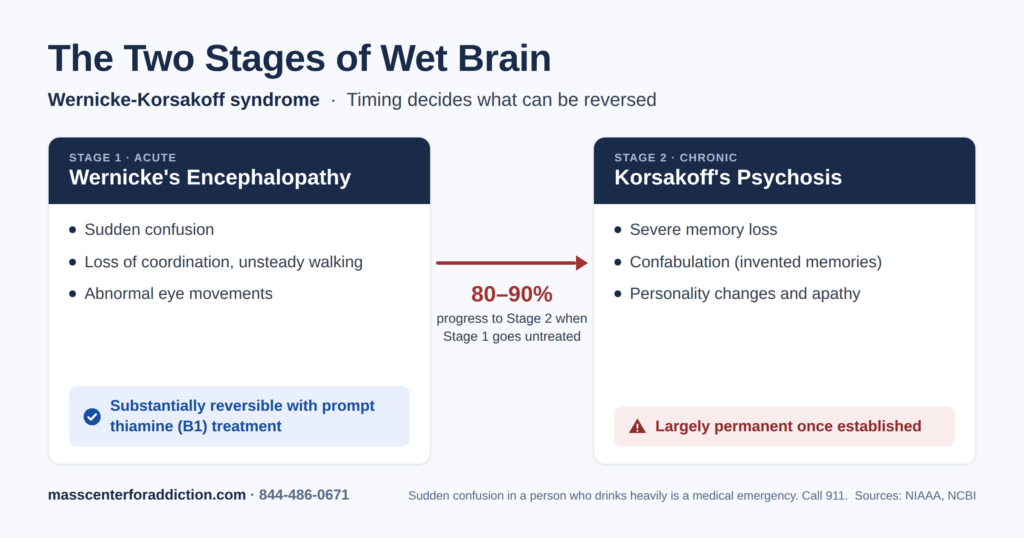
Wernicke’s Encephalopathy (Stage 1)
Wernicke’s encephalopathy is the acute stage, and it is a medical emergency on the same tier as a stroke. The classic triad of symptoms is confusion, loss of muscle coordination (ataxia), and abnormal eye movements or paralysis of the eye muscles.
Here is the detail that gets people killed: only about 1 in 10 patients shows all three signs at once, so clinicians and families alike look at a confused, stumbling person who drinks heavily and conclude they are simply drunk. Untreated, Wernicke’s encephalopathy is fatal in roughly one in five cases, and survivors who go untreated slide toward the second stage.
Treated promptly with high-dose thiamine, many Wernicke’s symptoms begin improving within days. That narrow window is the entire reason to know this condition exists.
Korsakoff’s Psychosis (Stage 2)
Among people who misuse alcohol, 80 to 90 percent of untreated Wernicke’s cases progress to Korsakoff’s psychosis, the chronic stage. Its signature is profound memory damage: the person cannot form new memories, loses stretches of old ones, and, most disorienting for families, fills the gaps with confabulation.
Confabulation is not lying. The brain, missing a memory it expects to find, manufactures a plausible one, and the person genuinely believes the detailed story they just told you about a conversation that never happened. Personality changes, apathy, and difficulty with decisions round out the picture, while other abilities, even social graces, can remain strikingly intact.
Wernicke’s vs. Korsakoff’s at a Glance
| Wernicke’s encephalopathy | Korsakoff’s psychosis | |
|---|---|---|
| What it is | Acute brain inflammation from thiamine deficiency | Chronic memory disorder from untreated Wernicke’s |
| Onset | Can appear over days | Develops gradually as stage 1 goes untreated |
| Hallmark signs | Confusion, loss of coordination, abnormal eye movements | Severe memory loss, confabulation, personality change |
| Urgency | Medical emergency, call 911 | Needs ongoing medical care and support |
| Reversibility | Substantially reversible with prompt thiamine | Largely permanent; some improve partially with sustained abstinence |
| Treatment | High-dose IV thiamine, then oral thiamine | Abstinence, nutrition, memory support, structured care |
Who Is Most at Risk?
The condition skews toward men between 30 and 70 with long histories of heavy daily drinking, but the deeper risk factor is the combination of heavy alcohol use with poor nutrition: people who drink most of their calories, skip meals during binges, or have gut or liver conditions that further impair absorption.
Bariatric surgery, prolonged vomiting, and eating disorders can produce the same deficiency without alcohol, which is why WKS occasionally appears in people who do not drink at all. If heavy drinking and a shrinking diet describe someone in your life, that pairing is the warning to act on.
Why 4 in 5 Cases Are Missed
The NIAAA’s estimate that around 80 percent of cases go undiagnosed comes down to camouflage. Confusion and stumbling in a person who drinks heavily gets read as intoxication. The same symptoms during a hospital stay get read as withdrawal. And because fewer than 1 in 10 patients shows the full textbook triad, nothing forces the correct diagnosis unless someone thinks to consider it.
The fix is disarmingly simple and worth memorizing: emergency clinicians will screen for it when told about the drinking. Being specific about how much and how often a person actually drinks, at the ER or any hospital admission, is the single highest-value sentence a family member can say.
The First Signs, and How Long Wet Brain Takes to Develop
The earliest signs are easy to write off: unusual clumsiness or unsteady walking, mental fog beyond a normal hangover, memory slips, irritability, and rapid eye movements or a new squint. In someone who drinks heavily every day, any sudden change in confusion or coordination deserves an emergency evaluation, not a wait-and-see.
There is no fixed timeline for developing WKS. The underlying thiamine deficiency typically builds over years of heavy drinking and poor nutrition, but the visible crisis of Wernicke’s encephalopathy can arrive abruptly once reserves run out, sometimes triggered by an illness, a period of vomiting, or hospitalization that pushes an already-depleted system over the edge. This is one more risk that stacks up in late-stage alcoholism, alongside the liver and heart damage covered in our post on the physical effects of alcoholism.
Is Wet Brain Reversible?
Partly, and the dividing line is speed. Treated in time, the eye symptoms and much of the confusion of Wernicke’s encephalopathy can improve within roughly 5 to 12 days of thiamine therapy, and coordination often recovers over weeks to months. Once Korsakoff’s psychosis is established, the memory damage is largely permanent: the NIAAA states plainly that Korsakoff’s is not reversible, though a portion of patients regain some function with sustained abstinence, good nutrition, and support, and full recovery is rare.
Read those two sentences together, and the takeaway is clear: wet brain is one of the few alcohol complications where acting today versus next month can decide whether a person keeps their memory.
How Wet Brain Is Treated
Suspected Wernicke’s encephalopathy is treated in a hospital with high-dose intravenous thiamine, typically 200 to 500 mg two to three times daily for the first several days under clinical guidelines, alongside fluids, electrolytes, and other B vitamins, before transitioning to oral thiamine.
A crucial detail for families at the ER: thiamine should be given before or alongside glucose, because sugar without thiamine can make the deficiency acutely worse. Diagnosis is clinical, sometimes supported by MRI showing changes in the brain’s memory structures, and because the condition is so often missed, saying the words “he drinks heavily, could this be Wernicke’s” to the treating team is a legitimate and sometimes decisive act of advocacy.
After the emergency, treatment has two tracks that cannot be separated: the brain needs sustained abstinence to stop the damage, and the person needs structure to sustain the abstinence. Stopping alcohol abruptly after heavy daily use carries its own serious risks, covered in our guide to alcohol withdrawal, so this transition belongs under medical supervision. Our team coordinates supervised alcohol detox and continues care through our alcohol addiction treatment program in Quincy: 844-486-0671.
Supporting a Loved One With Wernicke-Korsakoff Syndrome
Caring for someone with Korsakoff’s is its own education. Arguing with confabulation does not work; the person is not lying, and correction usually produces distress without producing memory. Families do better with gentle redirection, consistent routines, written notes and calendars as external memory, and one-thing-at-a-time communication.
Just as important: the caregiver needs support too. Our family program exists for exactly this, and our guide on helping someone with alcoholism covers the harder conversation that often still needs to happen, because many people with early WKS are still drinking.
The Part That Is Fully Preventable
Wet brain is one of the most preventable severe outcomes of alcohol use disorder. Every case starts with a long stretch of heavy drinking during which treatment would have interrupted the process, and thiamine deficiency itself is detectable and correctable. If someone you love drinks heavily and this page has been sitting with you, that is reason enough to call.
We will help you sort out what you are seeing and what to do next, whether that starts with an ER, a detox placement, or a conversation: 844-486-0671.
Frequently Asked Questions About Wet Brain
The nickname is old slang tied to alcohol (“getting wet”) and to the brain swelling seen in severe cases. Nothing about the brain is literally wet. The medical name is Wernicke-Korsakoff syndrome, and clinicians prefer it because it names the actual condition instead of a stereotype.
Early signs include unusual confusion or mental fog, unsteady walking or new clumsiness, abnormal or rapid eye movements, memory slips, and irritability. In a person who drinks heavily, sudden confusion plus poor coordination should be treated as a medical emergency, because those are hallmark signs of Wernicke’s encephalopathy.
The thiamine deficiency behind wet brain usually builds over years of heavy drinking and poor nutrition, but the acute crisis can appear abruptly once the body’s reserves are exhausted, sometimes triggered by illness or a stretch of not eating. There is no safe threshold of years; risk tracks with how heavily someone drinks and how depleted their nutrition is.
The first stage, Wernicke’s encephalopathy, is substantially reversible when treated promptly with high-dose thiamine; improvement often begins within 5 to 12 days. The second stage, Korsakoff’s psychosis, is largely permanent, though some people regain partial function with sustained abstinence, nutrition, and support. Speed of treatment is the deciding factor.
Yes. Untreated Wernicke’s encephalopathy is fatal in roughly one in five cases, and it can progress to coma. This is why sudden confusion in a person who drinks heavily warrants a 911 call rather than waiting to see if it passes. With prompt hospital treatment, deaths are uncommon.
No, though they can look similar. Korsakoff’s psychosis is a specific memory disorder caused by thiamine deficiency, while dementia describes broader progressive cognitive decline with many causes. Unlike most dementias, Korsakoff’s does not usually keep progressing if the person stops drinking and maintains good nutrition, which makes an accurate diagnosis important.
Clinically reviewed by Corey Gamberg, LADC II, Executive Director. This article is for educational purposes and is not a substitute for medical advice. If someone is showing sudden confusion, loss of coordination, or eye abnormalities, call 911 now. For mental health crisis support, call or text 988.


Contact Us

Address
Quincy, MA 02169


Start your recovery with
Massachusetts Center for Addiction
Our team is available 24 hours a day, 7 days a week to answer any questions you may have. Give us a call today and begin your journey toward long-term recovery.