

Sep 28, 2026
Gray Area Drinking and When Your Drinking Is Becoming a Problem
Gray area drinking, also spelled grey area drinking, is drinking that is more than you want but does not look like the stereotype of alcoholism. There is no crisis, no lost job, and no one has said anything, but you think about it more than you would like and cutting back is harder than it should be.
It is not a diagnosis. It is a useful name for a very common place to be, and it is often the easiest point to change course.
Below is what gray area drinking looks like, how much alcohol is too much under current guidance, a quick self-check, and what to do next.
What Is Gray Area Drinking
The term was popularized by Jolene Park, whose TED talk described the space between the extremes of rock bottom and every-now-and-then drinking. Most people who drink live somewhere in that space, and most of them never fit the picture of an “alcoholic” they grew up with.
A gray area drinker usually functions well. The drinking shows up as a habit that is hard to break, a nightly glass that became two or three, or a pattern of promising yourself a dry week and not quite getting there.
Signs of Gray Area Drinking
None of these alone means much. Several together describe the gray area:
- Drinking most nights to unwind, and feeling that evenings are incomplete without it
- Making rules, like only on weekends or only wine, and rewriting them
- Drinking more than you planned more often than you would like to admit
- Waking at 3 a.m. with a racing mind, or feeling anxious the next day (sometimes called hangxiety)
- Needing more to feel the same effect, a sign of rising alcohol tolerance
- Trying a month off and finding it much harder than expected
- Nobody else has noticed, but you have
If you are drinking every night, the question is less “is this alcoholism” and more “could I stop for two weeks without much trouble.” Your honest answer tells you a lot.
How Much Alcohol Is Too Much
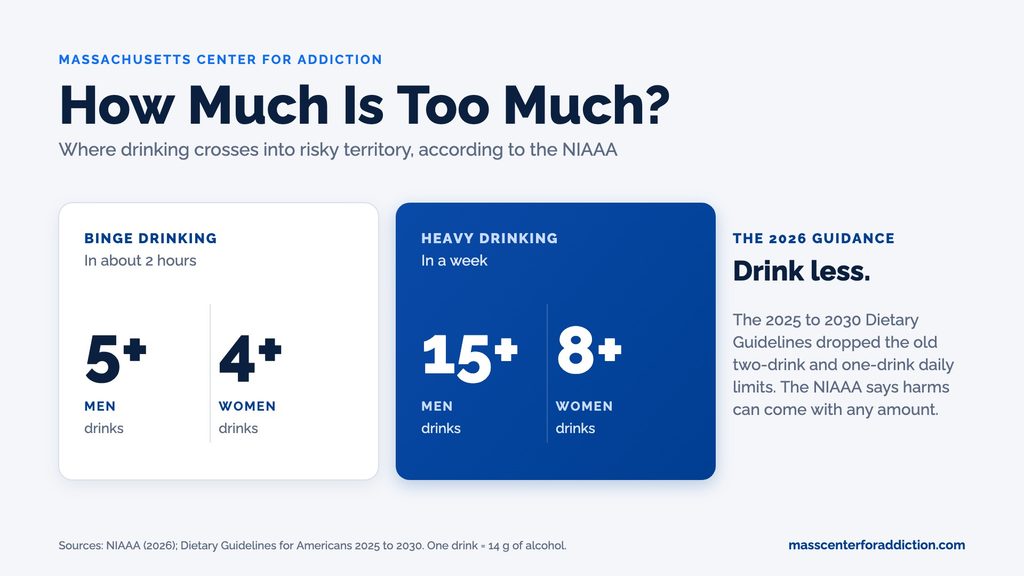
The National Institute on Alcohol Abuse and Alcoholism (NIAAA) defines risky drinking by amount. One standard drink is 12 ounces of beer, 5 ounces of wine, or 1.5 ounces of liquor.
| Men | Women | |
|---|---|---|
| Binge drinking | 5 or more drinks in about 2 hours | 4 or more drinks in about 2 hours |
| Heavy drinking | 5 or more on any day, or 15 or more a week | 4 or more on any day, or 8 or more a week |
For years, federal guidelines also defined moderate drinking as up to two drinks a day for men and one for women. The 2025 to 2030 Dietary Guidelines, released in January 2026, dropped those numbers and now simply advise drinking less.
The NIAAA notes that harms may come with any amount and rise as drinking increases. In January 2025 the U.S. Surgeon General also issued an advisory on alcohol and cancer, linking drinking to at least seven types of cancer, including breast, colorectal, and liver cancer.
Gray Area Drinking vs Alcohol Use Disorder
Clinicians diagnose alcohol use disorder using 11 criteria, such as drinking more than intended, trying and failing to cut down, cravings, and continuing despite problems. Two or three criteria in a year is mild, four or five is moderate, and six or more is severe.
Many people who call themselves gray area drinkers would meet the criteria for mild alcohol use disorder. That is not a reason for alarm; it means the pattern is real and it responds well to early, lighter-touch help.
Our pages on the warning signs of alcoholism, high-functioning alcoholism, and the stages of alcoholism cover what the next steps along that path look like.
A Quick Self-Check
The AUDIT-C is a three-question screen used by the VA and many primary care offices. Each answer scores from 0 to 4:
- How often did you have a drink containing alcohol in the past year?
- How many drinks did you have on a typical day when you were drinking?
- How often did you have six or more drinks on one occasion?
A total of 4 or more for men, or 3 or more for women, is considered a positive screen. It is not a diagnosis, but it is a good reason to take a closer look with a professional.
Why the Gray Area Is Hard to Leave
Gray area drinking is hard to change precisely because nothing is forcing the issue. There is no clear bottom, drinking is normal in most social circles, and the costs are quiet: worse sleep, more anxiety, less energy, a few too many foggy mornings.
For many people alcohol is also doing a job, like managing stress, social anxiety, or loneliness. Cutting back works better when you find another way to do that job.
How to Cut Back on Drinking
Mindful drinking and cutting back work for some gray area drinkers. What helps most:
- Track it for two weeks before changing anything, so you know your real starting point
- Set specific limits, such as alcohol-free weeknights, and decide them in advance
- Take a break of 30 days and notice what changes in sleep, mood, and energy
- Plan for your triggers, like the 6 p.m. wind-down or Friday plans, with a real alternative
- Tell one person what you are doing so it is not only in your head
The NIAAA’s free Rethinking Drinking site has calculators and tools for this.
When to Get Help
Get support if you have tried to cut back and could not, if drinking is tied to anxiety or depression, or if you are hiding how much you drink. Those are signs that willpower alone is not the right tool.
If you feel shaky, sweaty, anxious, or unable to sleep when you stop, you may be physically dependent. Do not stop suddenly on your own; talk to a clinician first, because alcohol withdrawal can be dangerous.
Massachusetts Center for Addiction in Quincy offers intensive outpatient and outpatient programs that fit around work, plus anxiety treatment when that is part of the picture. Call 844-486-0671 for a confidential conversation.
Frequently Asked Questions About Gray Area Drinking
Gray area drinking is a pattern between occasional social drinking and severe alcohol use disorder. You function well, but you drink more than you want, think about it more than you would like, and find cutting back harder than expected.
Both spellings mean the same thing. Gray is the American spelling and grey the British one.
It can be. Drinking every night builds tolerance and dependence, and the NIAAA notes that harms rise with the amount you drink. A good test is whether you could stop for two weeks without much difficulty.
The NIAAA defines heavy drinking as 5 or more drinks on any day or 15 or more a week for men, and 4 or more on any day or 8 or more a week for women. Current federal guidelines advise drinking less, and harms may come with any amount.
Not always. Gray area drinking is not a diagnosis, but many people in the gray area would meet the criteria for mild alcohol use disorder. That pattern responds well to early help.
Track your drinking first, set specific limits in advance, try a 30-day break, plan for your triggers, and tell someone you trust. If you cannot cut back or feel shaky when you stop, talk to a clinician.
Consider help if you have tried and failed to cut back, if drinking is tied to anxiety or depression, if you hide how much you drink, or if you have withdrawal symptoms when you stop.
Clinically reviewed by Corey Gamberg, LADC II, Executive Director. This article is for educational purposes and is not a substitute for medical advice. If you are experiencing a medical emergency, call 911. For mental health crisis support, call or text 988.


Contact Us

Address
Quincy, MA 02169


Start your recovery with
Massachusetts Center for Addiction
Our team is available 24 hours a day, 7 days a week to answer any questions you may have. Give us a call today and begin your journey toward long-term recovery.